In a nutshell
Purpose
premise enables the alignment of life cycle inventories within the ecoinvent 3.5-3.12 database, using either a “cut-off” or “consequential” system model, to match the output results of Integrated Assessment Models (IAMs) such as REMIND (and REMIND-EU), IMAGE, TIAM-UCL, MESSAGE or GCAM. This allows for the creation of life cycle inventory databases under future policy scenarios for any year between 2005 and 2100. Consequential system model support is limited to ecoinvent 3.8+.
Scope and boundaries
premise updates selected parts of ecoinvent to reflect IAM scenarios. It does not rebuild the entire database from scratch, and some sectors remain unchanged unless explicitly mapped. Results depend on the IAM model, scenario, year, and the ecoinvent version used.
External data dependencies
Beyond IAM scenario files, premise relies on curated external datasets and
additional inventories for several sectors. These are packaged in the repository
under premise/data and include:
Additional inventories used to extend ecoinvent (
premise/data/additional_inventories).GAINS emission factors for non-CO2 pollutants (
premise/data/GAINS_emission_factors).Renewables performance data such as PV efficiencies and wind tech parameters (
premise/data/renewables).Battery energy density projections and scenario shares (
premise/data/battery).Metals and mining datasets for material intensities and market shares (
premise/data/metals,premise/data/mining).Fuel and hydrogen parameters such as losses and supply-chain data (
premise/data/fuels).Sector-specific inventories for cement, steel, transport, and CDR updates (mappings under
premise/iam_variables_mappingand inventories underpremise/data).
These inputs are versioned with the code to keep results reproducible when using the same premise release.
Note
The ecoinvent database is not included in this package. You need to have a valid license for ecoinvent 3.5-3.12 to use premise. Also, please read carefully ecoinvent’s EULA before using premise.
IAM data access
Some IAM scenario files are encrypted. Access requires an encryption key from the developers.
Publication
The methodology behind premise is described in the following publication:
R. Sacchi, T. Terlouw, K. Siala, A. Dirnaichner, C. Bauer, B. Cox, C. Mutel, V. Daioglou, G. Luderer, PRospective EnvironMental Impact asSEment (premise): A streamlined approach to producing databases for prospective life cycle assessment using integrated assessment models, Renewable and Sustainable Energy Reviews, 2022, https://doi.org/10.1016/j.rser.2022.112311.
Note
If you use premise in your research, please cite the above publication.
Reproducibility
Outputs are reproducible when using the same premise version, IAM scenario files, and ecoinvent release. Changing any of these inputs will change the resulting database.
Additionally, you may want to cite the ecoinvent v.3 database:
Wernet, G. et al. The ecoinvent database version 3 (part I): overview and methodology. Int. J. Life Cycle Assess. 21, 1218–1230 (2016) . http://link.springer.com/10.1007/s11367-016-1087-8.
Finally, you should properly refer the IAM model used with premise:
REMIND: Baumstark et al. REMIND2.1: transformation and innovation dynamics of the energy-economic system within climate and sustainability limits, Geoscientific Model Development, 2021.
IMAGE: Stehfest, Elke, et al. Integrated assessment of global environmental change with IMAGE 3.0: Model description and policy applications. Netherlands Environmental Assessment Agency (PBL), 2014.
TIAM-UCL: Pye, S., et al. The TIAM-UCL Model (Version 4.1.1) Documentation, 2020.
MESSAGEix-GLOBIOM-GAINS: Daniel Huppmann, Matthew Gidden, Oliver Fricko, Peter Kolp, Clara Orthofer, Michael Pimmer, Nikolay Kushin, Adriano Vinca, Alessio Mastrucci, Keywan Riahi, Volker Krey, The MESSAGEix Integrated Assessment Model and the ix modeling platform (ixmp): An open framework for integrated and cross-cutting analysis of energy, climate, the environment, and sustainable development, Environmental Modelling & Software, 2019, https://doi.org/10.1016/j.envsoft.2018.11.012.
GCAM: Calvin, K., Patel, P., Clarke, L., Asrar, G., Bond-Lamberty, B., Cui, R. Y., Di Vittorio, A., Dorheim, K., Edmonds, J., Hartin, C., Hejazi, M., Horowitz, R., Iyer, G., Kyle, P., Kim, S., Link, R., McJeon, H., Smith, S. J., Snyder, A., Waldhoff, S., and Wise, M.: GCAM v5.1: representing the linkages between energy, water, land, climate, and economic systems, Geosci. Model Dev., 12, 677–698, https://doi.org/10.5194/gmd-12-677-2019, 2019.
Models
Model |
Description |
|---|---|
REMIND |
REMIND (Regionalized Model of Investment and Development) is an integrated assessment model that combines macroeconomic growth, energy system, and climate policy analysis. It is designed to analyze long-term energy transition pathways, accounting for technological, economic, and environmental factors. REMIND simulates how regions invest in different technologies and energy resources to balance economic growth and climate targets, while considering factors like energy efficiency, emissions, and resource availability. The model is particularly strong in its detailed representation of energy markets and macroeconomic interactions across regions, making it valuable for global climate policy assessments. |
REMIND-EU |
REMIND-EU is a regionalized version of the REMIND model, specifically tailored to analyze energy systems and climate policies within the European Union. It incorporates detailed representations of EU member states’ energy markets, technological options, and policy frameworks. It allows for a more granular analysis of how EU-specific policies, such as the European Green Deal, affect energy transition pathways, emissions reductions, and economic development within the EU context. |
IMAGE |
IMAGE (Integrated Model to Assess the Global Environment) is a comprehensive IAM developed to explore the interactions between human development, energy consumption, and environmental systems over the long term. It focuses on assessing how land use, food systems, energy systems, and climate change interact under different policy scenarios. The model integrates biophysical processes, such as land-use change and greenhouse gas emissions, with socio-economic drivers like population growth and economic development. IMAGE is commonly used for analyzing sustainable development strategies, climate impacts, biodiversity loss, and exploring mitigation and adaptation options. |
TIAM-UCL |
TIAM-UCL (TIMES Integrated Assessment Model by University College London) is a global energy system model based on the TIMES (The Integrated MARKAL-EFOM System) framework, developed to evaluate long-term decarbonization pathways for global energy systems. It provides detailed insights into energy technology options, resource availability, and emission reduction strategies under various climate policy scenarios. The model focuses on the trade-offs and synergies between energy security, economic costs, and environmental outcomes. TIAM-UCL is frequently used to analyze scenarios consistent with the Paris Agreement and examine technological innovation’s role in mitigating climate change globally. |
MESSAGE |
MESSAGEix-GLOBIOM-GAINS (MESSAGE) couples the MESSAGEix energy system with the GLOBIOM land-use model and GAINS air-pollution module. It is used to explore long-term energy and land-use transitions and their climate and air-quality implications under different policy scenarios. |
GCAM |
GCAM (Global Change Analysis Model) is an integrated assessment model that simulates the interactions between energy, water, land use, climate, and economic systems on a global scale. It is designed to analyze how different policy scenarios, technological developments, and socio-economic factors influence greenhouse gas emissions, energy production and consumption, land use changes, and climate outcomes. GCAM incorporates detailed representations of energy technologies, agricultural systems, and land-use dynamics, allowing for comprehensive assessments of mitigation strategies and their implications for sustainable development. The model is widely used for exploring pathways to achieve climate targets while considering trade-offs across multiple sectors. |
Quick Reference
Property |
REMIND |
REMIND-EU |
IMAGE |
TIAM-UCL |
MESSAGE |
GCAM |
|---|---|---|---|---|---|---|
Model Type |
CGE + Energy |
CGE + Energy |
IAM (PEM) |
Bottom-up |
Bottom-up (energy system) |
IAM (PEM) |
Foresight |
✓ Perfect |
✓ Perfect |
✗ Myopic |
✓ Perfect |
✓ Perfect |
✗ Myopic |
Energy System |
✓ Detailed |
✓ Detailed |
✓ Moderate |
✓ Very detailed |
✓ Very detailed |
✓ Moderate |
Land Use |
✓ (MAGPIE) |
✓ (MAGPIE) |
✓ Integrated |
✗ |
✓ Integrated (GLOBIOM) |
✓ Integrated |
Regional Focus |
Global |
EU + Global |
Global |
Global |
Global |
Global |
Key Strength |
Energy-economy |
EU policies |
Land & climate |
Tech pathways |
Energy system + land/air |
Coupled land–water–energy |
REMIND
REMIND (Regionalized Model of Investment and Development) is a CGE-based energy-economy IAM with perfect foresight. Its main strength lies in capturing interactions between macroeconomic growth and energy transitions across 12–13 global regions. Compared to IMAGE, REMIND provides more detailed energy market and investment dynamics, but it lacks IMAGE’s rich land-use and biodiversity modules. Compared to TIAM-UCL, REMIND emphasizes macroeconomic feedbacks over technological granularity, making it better for studying long-term global climate policies rather than detailed technology pathways. REMIND-EU builds directly on REMIND but adds EU-specific regionalization.
REMIND-EU
REMIND-EU is a regionalized version of REMIND, designed to analyze the European Union’s energy transition with country-level resolution (at least, for France, Germany, and the UK). It retains REMIND’s CGE approach and perfect foresight but includes EU-specific policies and technologies, which are less detailed in the global REMIND model. Compared to IMAGE, REMIND-EU still lacks a strong land-use component, but its granularity for EU energy systems makes it preferable for studying European Green Deal scenarios. Compared to TIAM-UCL, REMIND-EU has less technology detail but better macroeconomic and cross-sectoral insights for EU policymaking.
IMAGE
IMAGE (Integrated Model to Assess the Global Environment) is a simulation-based IAM with a recursive-dynamic structure (myopic foresight). It excels in land-use, agriculture, and biodiversity modeling, making it the best choice for scenarios that involve climate–ecosystem interactions. Compared to REMIND and TIAM-UCL, IMAGE has less detailed energy system modeling and no explicit macroeconomic CGE framework. However, its biophysical integration and land-use modeling (unlike TIAM-UCL, which lacks this entirely) makes it complementary to energy-focused models.
TIAM-UCL
TIAM-UCL is a bottom-up, technology-rich energy system model based on linear optimization with perfect foresight. It focuses on detailed technology pathways, energy supply chains, and long-term decarbonization strategies. Compared to REMIND and IMAGE, TIAM-UCL lacks macroeconomic modeling and has no integrated land-use module, but it provides superior technology detail and resource-specific analyses (e.g., hydrogen pathways, renewables deployment). It is particularly suited for Paris Agreement-compliant energy transitions and cost-optimal technology portfolios.
MESSAGE
MESSAGEix-GLOBIOM-GAINS (MESSAGE) is an energy-system optimization IAM coupled with the GLOBIOM land-use model and the GAINS air-pollution module. It provides detailed energy system pathways with explicit links to land-use and air-quality outcomes. Compared to REMIND, it is less focused on macroeconomic feedbacks but offers stronger coupling to land-use and air-pollution dynamics. Compared to GCAM and IMAGE, it emphasizes cost-optimal energy system transformations while still capturing land-use interactions through GLOBIOM.
GCAM
GCAM (Global Change Analysis Model) is a recursive-dynamic IAM based on partial equilibrium with myopic foresight. Its distinguishing feature is the tight coupling of energy, land, water, and agriculture systems within a single framework. Compared to REMIND, GCAM lacks intertemporal optimization and macroeconomic feedbacks but offers richer integration of land and water systems. Compared to IMAGE, GCAM places stronger emphasis on regional bioenergy–land-use trade-offs and water constraints, although its energy system detail is slightly more stylized. Unlike TIAM-UCL, GCAM is not technology-optimization–driven, but it captures market-driven transitions in land and energy under policy constraints. This makes it especially suitable for analyzing cross-sectoral impacts of climate, land, and water policies in a globally consistent framework.
Choosing the Right IAM
Selecting the appropriate IAM for use with premise depends on the focus of your study:
REMIND is best suited for global energy–economy transition analyses where the interplay between macroeconomic growth, energy markets, and climate policies is key.
REMIND-EU is ideal for EU-focused studies, particularly those assessing the European Green Deal or country-level decarbonization strategies within the EU.
IMAGE is the preferred choice when land-use change, agriculture, biodiversity, or climate–ecosystem interactions are central to the analysis. Its biophysical and environmental modules complement energy-focused IAMs.
TIAM-UCL is most appropriate for exploring detailed technology pathways, resource allocation, and cost-optimal energy system designs, particularly for Paris Agreement-compatible scenarios.
MESSAGE is most suitable when you need cost-optimal energy system pathways with explicit land-use and air-pollution linkages.
GCAM is most suitable when the cross-sectoral links between land, water, energy, and agriculture are crucial. It is especially useful for questions involving bioenergy deployment, water scarcity constraints, or food–land competition under climate policy.
Our recommendation is to assess the sensitivity of your results across different IAMs for a given climate target. IAMs will deploy different technologies and resources to achieve the same climate target, which will lead to different life cycle inventories.
Additionally, the level of sectoral integration in premise varies across IAMs, which can affect the results.
This table below summarize the numbers of variables mapping with premise for each IAM and sector:
Sector |
image |
remind |
remind-eu |
tiam-ucl |
gcam |
message |
|---|---|---|---|---|---|---|
Biomass |
4 |
2 |
2 |
2 |
2 |
3 |
Carbon Dioxide Removal |
5 |
11 |
11 |
3 |
4 |
7 |
Cement |
45 |
4 |
4 |
7 |
12 |
26 |
Crops |
10 |
0 |
0 |
1 |
10 |
0 |
Electricity |
51 |
34 |
34 |
61 |
41 |
43 |
Fuels |
56 |
49 |
49 |
55 |
48 |
24 |
Heat |
38 |
24 |
24 |
2 |
13 |
30 |
Other |
4 |
4 |
4 |
4 |
4 |
4 |
Steel |
117 |
42 |
42 |
119 |
23 |
14 |
Transport Bus |
10 |
8 |
8 |
12 |
10 |
0 |
Transport Passenger Cars |
10 |
60 |
60 |
29 |
30 |
0 |
Transport Rail Freight |
10 |
7 |
7 |
6 |
10 |
0 |
Transport Road Freight |
38 |
40 |
40 |
90 |
29 |
0 |
Transport Sea Freight |
16 |
15 |
15 |
37 |
12 |
0 |
Transport Two Wheelers |
0 |
12 |
12 |
0 |
6 |
0 |
And here is a plot of the same data:

The table and plot show how premise connects to IMAGE, REMIND, REMIND-EU, TIAM-UCL, GCAM, and MESSAGE, focusing on energy generation, industry, and transport:
TIAM-UCL has the largest coverage in this table (428 variables), with strong detail in steel (119), electricity (61), fuels (55), and road freight (90).
IMAGE also offers broad integration (414 variables), with high counts in steel (117), fuels (56), electricity (51), and cement (45). Two-wheelers are not covered by IMAGE.
REMIND and REMIND-EU have identical coverage (312 variables each), with particularly strong detail in passenger cars (60), fuels (49), and road freight (40).
GCAM provides moderate coverage (254 variables), with strength in electricity (41), fuels (48), and cross-sector integration of land, water, agriculture, and energy.
MESSAGE includes 151 mapped variables and currently does not include transport-sector mappings.
Sectoral observations:
Electricity and fuels remain among the most consistently mapped sectors across all models.
Transport sub-sectors (bus, passenger cars, rail, road, and sea freight) are well represented in REMIND(-EU), TIAM-UCL, and GCAM, with IMAGE covering all except two-wheelers.
MESSAGE scenarios currently do not have transport-sector mappings in premise.
Industrial sectors are strongly represented in IMAGE and TIAM-UCL, especially for steel and cement.
IMAGE
Strengths:
Strong coverage of electricity (51 variables) and fuels (56 variables).
Detailed industrial sectors, especially cement (45) and steel (117).
Broad mapping across transport sub-sectors, except for two-wheelers.
Limitation:
No coverage of two-wheelers, and fewer transport details than REMIND for passenger cars.
REMIND
Strengths:
Broad coverage of electricity (34) and fuels (49).
Highly detailed transport, with 60 variables for passenger cars and 40 for road freight.
Comprehensive coverage of carbon dioxide removal (11).
Limitation:
Less detailed in cement and steel compared to IMAGE and TIAM-UCL.
REMIND-EU
Strengths:
Same broad mapping as REMIND, but with EU-specific detail.
Excellent coverage of transport and fuels, aligned with EU decarbonization pathways.
Includes CO₂ removal (11) and electricity (34) in high detail.
Limitations:
Industrial coverage (cement 4, steel 42) is moderate compared to IMAGE and TIAM-UCL.
Not as many scenarios available as for REMIND.
TIAM-UCL
Strengths:
Strong focus on electricity (61) and fuels (55).
Detailed road freight (90) and transport mapping.
Good coverage of passenger cars (29 variables).
Limitation:
Limited representation of heat (2) and carbon dioxide removal (3) sectors.
GCAM
Strengths:
Integrated coverage of land, energy, water, and agriculture systems — GCAM’s key advantage over the other IAMs.
Moderate detail in electricity (41) and fuels (48), sufficient for energy–land–water linkages.
Includes biomass and CDR pathways with explicit land-use competition interactions.
Limitations:
Transport coverage is lower than REMIND(-EU) and TIAM-UCL for passenger cars and road freight.
Industrial detail is uneven across sectors (cement 12, steel 23), reflecting its broader systems focus rather than technology granularity.
MESSAGE
Strengths:
Good coverage in electricity (43), fuels (24), and heat (30).
Strong representation of cement-related mappings (26), alongside steel (14).
Includes biomass (3) and carbon dioxide removal pathways (7).
Limitations:
No transport-sector mappings are currently available (bus, passenger cars, rail, road, sea freight, and two-wheelers).
Coverage is lower than IMAGE, REMIND(-EU), and TIAM-UCL in several sectors, with 151 mapped variables in total.
Choosing the right scenario
The criteria for scenario selection depend on the objective of the study. One possible criterion is the climate target, which can be expressed as the global mean surface temperature (GMST) increase by 2100.
Here is a comparison across scenarios with respect to the global mean surface temperature (GMST) increase by 2100:
Scenario |
<1.5 |
1.5–1.7 |
1.7–2.0 |
2.0–2.5 |
2.5–2.8 |
2.8–3.0 |
3.0–3.2 |
3.2–3.5 |
>3.5 |
|---|---|---|---|---|---|---|---|---|---|
remind - SSP1-PkBudg650 |
✓ |
||||||||
image - SSP1-VLLO |
✓ |
||||||||
image - SSP2-VLHO |
✓ |
||||||||
remind - SSP2-PkBudg650 |
✓ |
||||||||
remind-eu - SSP2-PkBudg650 |
✓ |
||||||||
tiam-ucl - SSP2-RCP19 |
✓ |
||||||||
remind - SSP1-PkBudg1000 |
✓ |
||||||||
image - SSP2-L |
✓ |
||||||||
image - SSP1-L |
✓ |
||||||||
tiam-ucl - SSP2-RCP26 |
✓ |
||||||||
remind - SSP3-PkBudg1000 |
✓ |
||||||||
remind-eu - SSP2-PkBudg1000 |
✓ |
||||||||
remind - SSP2-PkBudg1000 |
✓ |
||||||||
gcam - SSP2-RCP26 |
✓ |
||||||||
remind - SSP1-NPi |
✓ |
||||||||
remind-eu - SSP2-NDC |
✓ |
||||||||
remind - SSP2-NDC |
✓ |
||||||||
remind - SSP3-NDC |
✓ |
||||||||
image - SSP1-Ma |
✓ |
||||||||
tiam-ucl - SSP2-RCP45 |
✓ |
||||||||
image - SSP2-M |
✓ |
||||||||
remind-eu - SSP2-NPi |
✓ |
||||||||
remind - SSP2-NPi |
✓ |
||||||||
tiam-ucl - SSP2-Base |
✓ |
||||||||
remind - SSP3-NPi |
✓ |
||||||||
remind - SSP2-rollBack |
✓ |
||||||||
image - SSP3-H |
✓ |
||||||||
gcam - SSP2-Base |
✓ |
||||||||
image - SSP5-H |
✓ |
||||||||
remind - SSP3-rollBack |
✓ |
||||||||
message - SSP1-VL |
✓ |
||||||||
message - SSP2-VL |
✓ |
||||||||
message - SSP1-L |
✓ |
||||||||
message - SSP2-LO |
✓ |
||||||||
message - SSP2-L |
✓ |
||||||||
message - SSP4-LO |
✓ |
||||||||
message - SSP5-LO |
✓ |
||||||||
message - SSP2-ML |
✓ |
||||||||
message - SSP2-M |
✓ |
||||||||
message - SSP3-H |
✓ |
||||||||
message - SSP5-H |
✓ |
And here is a plot of the same data:

Hence, the choice of model and scenario is usually a weighted trade-off between:
the characteristics of the model (e.g., regionalization, technology detail, land-use modeling, myopic vs. perfect foresight, etc.),
the climate target (e.g., 1.5°C, 2.0°C, etc.),
the extent of sectoral integration (e.g., how many sectors are mapped in premise), and
the availability of scenarios (e.g., some models have more scenarios than others).
Below is another list of the scenarios available in premise for each IAM, by SSP family and GMST increase by 2100.
CarbonBrief wrote a good article explaining the meaning of the SSP system.
Note that while scenarios are denominated by their SSP family, they do not follow a uniform system to describe the climate objective. For example, REMIND uses NDC, NPi and carbon peak budgets (650 and 1000 GtCO2e) climate trajectories, while IMAGE uses medium, low, and very low forcing scenarios (with or without overshoot). MESSAGE uses emissions and overshoot labels (e.g., Low, Very Low, Low Overshoot), and TIAM-UCL and GCAM use Representative Concentration Pathways (RCPs) to denote the climate target (e.g., RCP 1.9, 2.6, 4.5 and Base).
Additionally, we provided a summary of the main characteristics of each scenario here.
If you wish to use an IAM file which has not been generated by either of these above-listed models, you should refer to the Mapping section.
Workflow
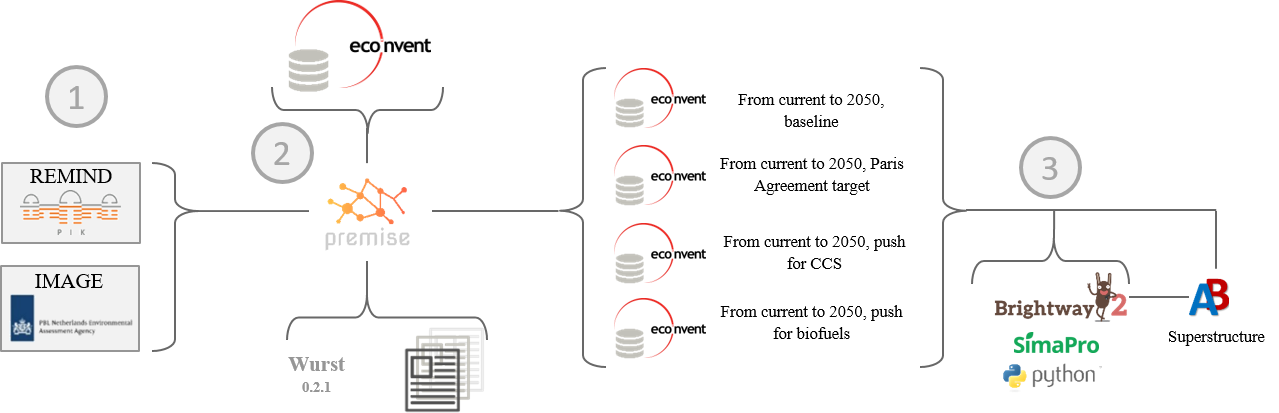
As illustrated in the workflow diagram above, premise follows an Extract, Transform, Load (ETL) process:
Extract the ecoinvent database from a Brightway project or from ecospold2 files.
Expand the database by adding additional inventories for future production pathways for certain commodities, such as electricity, heat, steel, cement, etc.
Modify the ecoinvent database, focusing primarily on process efficiency improvements and market adjustments.
Load the updated database back into a Brightway project or export it as a set of CSV files, such as Simapro CSV files.
Requirements
Python language interpreter >=3.9
License for ecoinvent 3
Brightway 2 or 2.5 (optional)
Note
If you wish to export Brightway 2.5-compatible databases, you will need to upgrade bw2data to >= 4.0.0.
How to install this package?
Two options:
From Pypi:
pip install premise
will install the package and the required dependencies.
premise comes with the latest version of brightway, which is Brightway 2.5.
This means that premise will output databases that are compatible with Brightway 2.5.
If you want to use the results in the Brightway 2 framework (e.g., to read them in activity-browser),
you need to specify it in the installation command:
pip install "premise[bw2]"
You can also specify that you want to use Brightway 2.5:
pip install "premise[bw25]"
A development version with the latest advancements (but with the risks of unseen bugs), is available from Anaconda Cloud. Similarly, you should specify that you want to use Brightway 2.5:
conda install -c conda-forge premise-bw25
Or rather use Brightway2 (for Activity Browser-compatibility):
conda install -c conda-forge premise-bw2
How to use it?
Examples notebook
This notebook will show you everything you need to know to use premise.
ScenarioLink plugin
There now exists a plugin for Activity Browser, called ScenarioLink, which allows you to directly download IAM scenario-based premise databases from the browser, without the use of premise. You can find it here.